
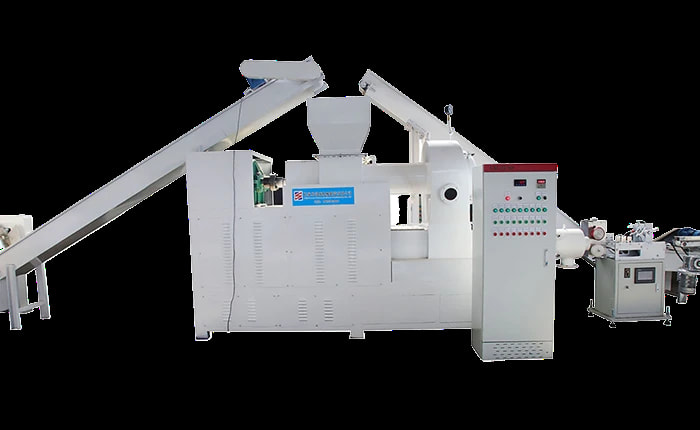
State-of-the-art professional soap making equipment illustrates the extreme mechanical tolerances required in modern high-viscosity extrusion. In the broader realm of industrial manufacturing, processing high-density materials—ranging from synthetic polymer blends to concentrated chemical bases—presents a unique set of metallurgical and mechanical challenges. Unlike low-viscosity liquids that can be easily transported via centrifugal pumps, highly dense compounds require immense, sustained mechanical force to be shaped, refined, and extruded. The architectural design of the machinery utilized in these critical final stages directly dictates the structural integrity, surface finish, and dissolution rate of the end product. Understanding the highly nuanced mechanics behind internal pressure gradients, die-swell phenomena, and thermal dispersion is an absolute necessity for any facility engineer aiming to achieve operational excellence and zero-defect manufacturing.
The Tribology and Physics of High-Viscosity Extrusion
When high-density compounds are forced under extreme pressure through a hardened steel extrusion barrel, they exhibit incredibly complex rheological behaviors. The internal worm shaft, or auger, must be engineered with absolute precision regarding its pitch, flight depth, and helical geometry. The goal is to maintain a continuous, volumetric forward flow without generating excessive back-pressure or causing the material to slip backward over the flights. If the auger's design is suboptimal for the specific compound being processed, it results in erratic output rates, fluctuating material density, and structural micro-fractures in the extruded billet. Advanced mechanical designers now utilize sophisticated Computational Fluid Dynamics (CFD) and Finite Element Analysis (FEA) to optimize these internal geometries. By ensuring a steady, perfectly calculated compression ratio along the entire length of the barrel, the machinery systematically forces the material into a highly plasticized, homogenous state, entirely eliminating microscopic air pockets before the compound reaches the final die plate.
Managing Die-Swell and Molecular Alignment
A critical phenomenon encountered in the extrusion of visco-elastic materials is "die-swell" (the Barus effect). When a polymer or dense chemical matrix is compressed through a shaping die, the polymer chains are forced into alignment. Upon exiting the die, the sudden release of pressure causes the molecular chains to recoil and expand, leading to a dimensional change in the extruded product. If not strictly controlled, this expansion ruins the dimensional tolerances of the final product, rendering it unsuitable for automated packaging or downstream assembly. To mitigate die-swell, engineers must carefully calibrate the length-to-diameter (L/D) ratio of the die land and precisely control the temperature profile at the exit point. By maintaining a specific thermal state, the material's relaxation time is optimized, ensuring that the extruded shape remains dimensionally stable and geometrically perfect as it transitions to the cutting or stamping phase.
Vacuum Degassing and the Pursuit of Absolute Density
Achieving a highly refined, premium texture requires multiple stages of intense mechanical manipulation prior to final shaping. Typically, materials first pass through heavy-duty three-roll grinders that exert immense hydraulic pressure to crush unreacted particles and aggressively align the molecular structure. However, the true hallmark of advanced material processing lies in the final extrusion phase. For specialized applications demanding exceptional density and flawless structural integrity, the utilization of a specialized simplex plodder machine is widely recognized as the industry standard. This equipment features a powerful, high-torque motor driving a precision-machined worm shaft, all enclosed within a rigorously maintained vacuum chamber. The vacuum environment is critical; it actively extracts entrapped microscopic air bubbles and volatile gases from the compounded mass. This degassing process prevents internal structural weaknesses, ensuring that the final extruded billet is rock-solid, completely uniform, and perfectly prepared for high-speed automated cutting and precision stamping.
The Impact of Metallurgy on Equipment Longevity
The continuous processing of dense, sometimes abrasive or corrosive chemical compounds places extraordinary wear and tear on manufacturing infrastructure. The science of metallurgy plays a pivotal role in the lifespan of this equipment. Standard carbon steels will quickly degrade, leading to metal contamination in the product and catastrophic machinery failure. Therefore, the augers, barrels, and die plates must be machined from specialized alloys, such as 316L stainless steel, and often undergo advanced surface hardening treatments like nitriding or tungsten carbide coating. These treatments drastically reduce the coefficient of friction and provide exceptional resistance to both chemical corrosion and mechanical abrasion. When facility managers source replacement parts or entirely new processing lines, verifying the exact metallurgical specifications of the wetted parts is a critical step in ensuring long-term operational viability.
Evaluating Advanced Suppliers for Scalable Infrastructure
Scaling up production capabilities in a high-viscosity processing plant necessitates rigorous, exhaustive due diligence when selecting mechanical infrastructure. The true cost of equipment failure in this sector extends far beyond immediate maintenance invoices; it manifests in massive batches of ruined raw materials, missed delivery schedules, and catastrophic production bottlenecks. Consequently, when industrial procurement officers evaluate machinery for sale, they must look far beyond superficial performance specifications. It is imperative to partner with a premium manufacturer known for stringent quality control, robust structural engineering, and the integration of state-of-the-art PLC automation. Reliable, high-quality providers offer more than just raw machinery—they provide engineered, scalable solutions. By integrating equipment backed by profound engineering expertise, factories can guarantee continuous, high-yield operation, ultimately protecting their capital investments and ensuring consistent superiority in their final product offerings.