
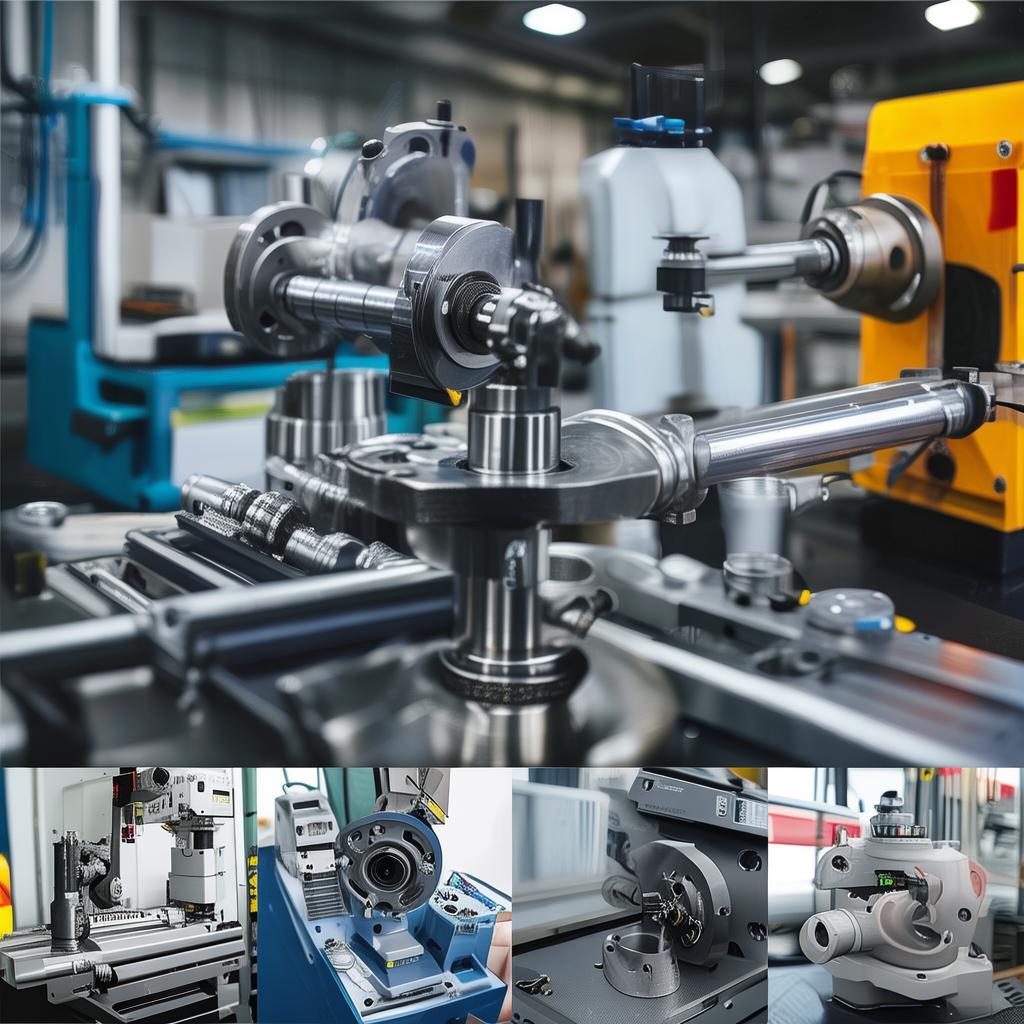
networked CNC machining center
Product Overview Networked CNC machining for production environments that require traceability, flexible routing, and consistent part quality.
A networked CNC machining center connects machining resources—controllers, tooling setups, sensors, and workholding changes—into a single connected shop-floor workflow. Built for industrial manufacturing, it supports modern production needs like remote diagnostics, centralized job dispatch, and data-driven quality management. Instead of operating as an isolated machine, the machining center becomes a node in your digital manufacturing system, helping teams respond faster to schedule changes and maintain uniform output across shifts and lines.
Typical buyers include aerospace and automotive supply chain manufacturers, precision job shops, and Tier manufacturers that need reliable CNC turning/milling capacity with streamlined communication between planning (ERP/MES), engineering (CAM), and the machine.
Key Features
- Connected production control enables easier job tracking, consistent execution of planned routes, and quicker rescheduling when priorities shift.
- Real-time machine visibility supports status monitoring and faster escalation for downtime, tool issues, or operator interventions.
- Quality-focused data collection helps reduce variation by keeping production records tied to part runs and machine conditions.
- Efficient setup and changeovers improves responsiveness for mixed-model production and short-run manufacturing strategies.
- Remote support readiness improves service turnaround through diagnostics and communication between your team and maintenance partners.
- Tooling and process stability is enhanced by standardized workflows and repeatable program loading practices.
- Scales across multiple machines making it easier to deploy additional CNC machining nodes without rebuilding your production logic.
Technical Specifications
| Parameter | Specification |
|---|---|
| Machine type | CNC machining center with network connectivity for shop-floor integration |
| Control & connectivity | Controller designed for data exchange with MES/SCADA/ERP workflows (integration-ready) |
| Data functions | Machine status tracking, run/job documentation, event and fault logging (as configured) |
| Programming support | Support for standard CNC programming workflows with repeatable job loading practices |
| Service readiness | Remote diagnostic capability depends on installed configuration and network access |
| Integration scope | Designed to connect machining execution with scheduling and quality traceability (MES/SCADA integration) |
| Safety & operational workflow | Conforms to standard industrial safety practices; exact requirements depend on your plant policy and configuration |
Note: Exact mechanical travel, spindle power, and accuracy parameters vary by configuration. Share your part requirements (materials, dimensions, tolerance targets) and we’ll specify the best-matched build.
Application Scenarios
- Aerospace machining support: improves run documentation and traceability for critical machined components.
- Automotive supply parts: helps coordinate mixed-model production with faster rescheduling across connected cells.
- Industrial tooling and fixtures: supports consistent repeat runs by standardizing job dispatch and setup workflows.
- Job shop capacity planning: provides visibility into machine utilization and downtime signals to optimize throughput.
Advantages
- Better integration, less manual coordination: a connected CNC platform reduces spreadsheet-based tracking and shortens the gap between planning and execution.
- Faster problem response: event logs and machine state data support quicker identification of tooling or process anomalies.
- More consistent production output: tying runs to job records and standardized workflows helps reduce variation between shifts and operators.
- Scalability for multi-machine plants: when you expand, the same digital logic can carry over to additional machining nodes.
- Service efficiency: remote diagnostic readiness can reduce downtime caused by delayed troubleshooting (dependent on your network setup).
Why Choose Us
We supply connected CNC solutions with a focus on practical deployment in manufacturing environments. Our team works with your engineering and operations stakeholders to align the connected workflow with your existing planning, quality, and maintenance processes—so the benefits of a networked machining architecture show up on the floor.
- Implementation support for integration planning and commissioning workflows (based on your system environment).
- Transparent communication during lead time, installation coordination, and handover.
- Ongoing service approach designed to reduce unplanned downtime and accelerate recovery.
- Process-oriented guidance for setup discipline, data capture, and repeatable job execution.
FAQ
1) What does a networked CNC machining center actually improve in daily production?
It improves visibility and coordination—job tracking, machine status monitoring, and run documentation—so production control becomes more reliable than manual communication.
2) Can this connected CNC solution work with our existing MES/ERP/SCADA?
Integration readiness is designed for shop-floor connectivity. Specific connectivity depends on your current system landscape and the configuration we deploy together.
3) Does the system help with quality traceability and audits?
Yes—when configured for run/event logging, you can tie production outcomes to machine conditions and job records to support traceability requirements.
4) How does this affect maintenance and service response time?
A connected machining cell can enable faster troubleshooting through event/fault logs and remote diagnostic readiness (where supported by your network and service setup).
5) Is the machine suitable for both batch production and short-run jobs?
Yes. The goal is to streamline setup discipline and job dispatch, which benefits mixed-model schedules and frequent changeovers.
6) What information do you need to recommend the right configuration?
Share your target workpieces, materials, required tolerances, production volume, and your integration environment. We’ll align the machining center configuration and connected workflow to your use case.
If you’re planning a connected machining rollout or upgrading isolated CNC capacity into a coordinated shop-floor workflow, request a quotation or send your part requirements. We’ll recommend the most suitable networked setup and integration approach for your production goals.