
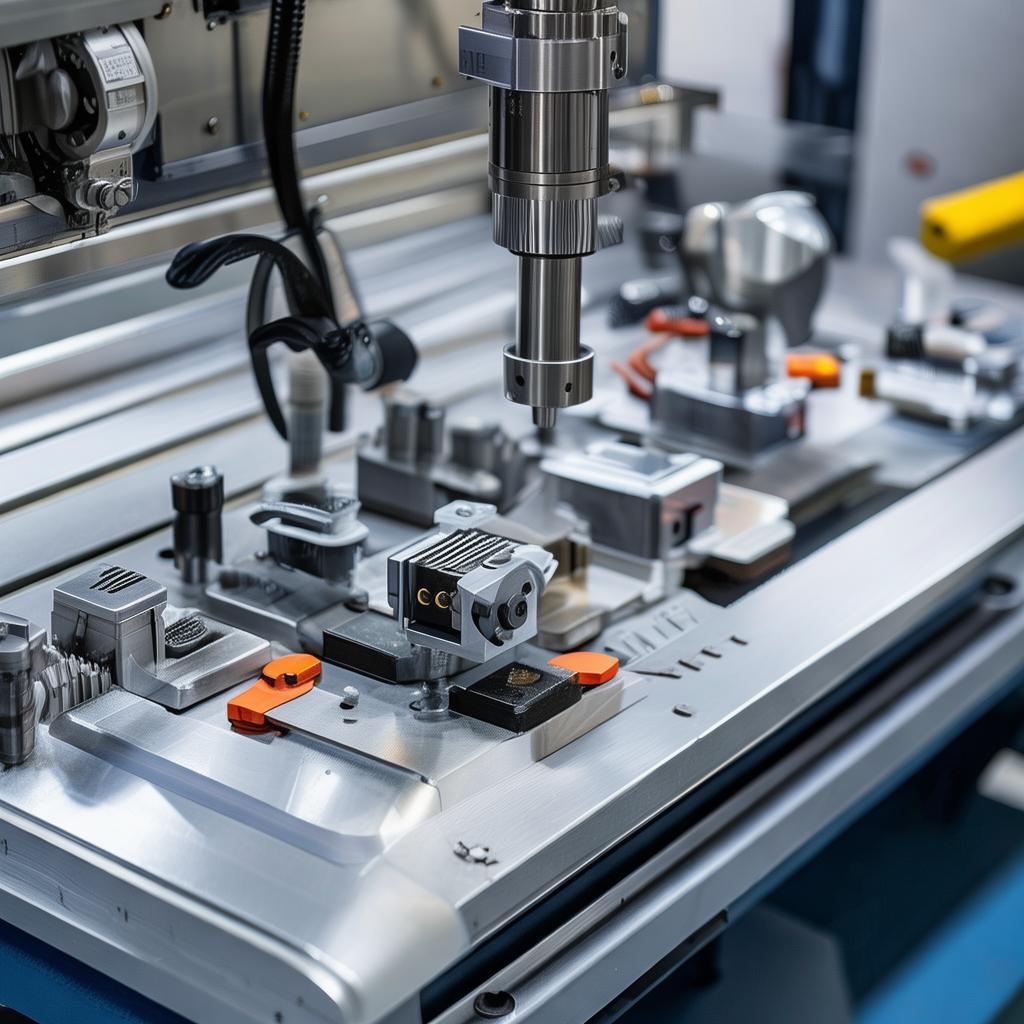
CNC router ball screw system
Product Overview
A CNC router ball screw system is a precision linear-motion drive assembly designed to convert motor rotation into smooth, controlled linear travel. In the industrial CNC machining and fabrication industry—where routers, gantry systems, and automated material-working platforms must hold tight positioning—ball screw technology is commonly used to improve motion accuracy, reduce friction, and support repeatable production cycles. For OEMs, machine builders, and distributors, this system helps you upgrade axis performance for woodworking routers, plasma/laser assist carriages, light-duty milling centers, and other CNC routers where reliability and predictable feed control matter.
Key Features
- Consistent positioning with refined lead accuracy and reduced mechanical play, supporting steadier cut paths and less “wandering” at speed.
- Lower friction for smoother motion, helping controllers maintain stable feed rates without frequent compensation or aggressive tuning.
- Improved efficiency that can reduce motor load and support more responsive acceleration/deceleration on router axes.
- Repeatable performance over duty cycles—beneficial for production environments that run the same jobs repeatedly.
- Reliable integration options with standard mounting approaches and flexible configuration to match common CNC router mechanical layouts.
- Better suitability for automation, where predictable motion improves overall machine stability and downstream quality.
- Service-friendly design to simplify maintenance planning during preventive upkeep or axis refurbishment.
Technical Specifications
Note: Exact parameters can be configured to your axis requirements (length, screw diameter, support style, and end machining). Refer to your inquiry for final selection.
| Parameter | Specification |
|---|---|
| Screw type | Recirculating ball screw (linear motion drive) |
| Typical mounting/support | End support options compatible with common router axis designs |
| Travel direction | Bi-directional linear feed for CNC axes |
| Intended use | CNC router gantry/linear axes and automated fabrication platforms |
| Controller compatibility | Stepper or servo system integration with appropriate coupling and encoder feedback |
| Backlash behavior | Designed for reduced play relative to lead screw alternatives (final selection depends on preload/tolerance) |
| Lubrication approach | Supports planned maintenance intervals for consistent friction and wear control |
| Configuration variants | Customizable travel length, screw size, and end machining for axis fitment |
Application Scenarios
- Gantry routers for sheet processing: upgrade linear axis drive for steadier feed motion during repeated toolpaths.
- Woodworking CNC with high cycle counts: reduce stiction/friction to support smoother transitions across corners and edges.
- Retrofit projects on existing machine frames: replace lead screw components with a ball screw drive to improve positioning repeatability.
- Automation-ready motion platforms: pair with servo control strategies to improve acceleration/deceleration behavior on router axes.
Advantages
Choosing a precision ball screw linear drive over generic alternatives can materially improve operational outcomes. A well-selected CNC router ball screw system reduces friction and mechanical play, which typically leads to more stable machining results and fewer motion-related adjustments during commissioning. Compared with basic lead screw configurations, ball screw drives are often better suited for applications where smoothness, repeatability, and predictable controller tuning influence throughput and scrap rates.
For machine builders, the value is not only performance—it’s also engineering efficiency. When the axis drive is chosen to match the travel, mounting geometry, and duty profile, your team spends less time compensating for inconsistent motion behavior and more time scaling production.
Why Choose Us
- Requirement-first sourcing: we help you select the right configuration for your axis layout, travel requirements, and integration approach.
- Transparent documentation support: we provide the information you need for procurement, compatibility checks, and assembly planning.
- Consistent supply for builders: we understand distributor and OEM timelines and support dependable ordering for multi-axis builds.
- Practical after-sales coordination: our team supports troubleshooting workflows during installation and commissioning.
If you share your existing axis drawings or BOM, we can validate fitment for your specific CNC router configuration.
FAQ
Q1: What axes are best suited for a ball screw drive on CNC routers?
A: Linear X/Y gantry axes and Z axes are common. The best fit depends on travel length, speed/acceleration targets, load profile, and your existing support geometry.
Q2: How does the CNC router ball screw system improve machining quality?
A: By reducing friction and mechanical play, motion becomes smoother and more repeatable. That helps maintain more consistent feed behavior, especially during direction changes and complex toolpaths.
Q3: Can this be used for retrofit upgrades?
A: Yes, many teams retrofit existing router frames. We’ll confirm screw length, end machining, mounting orientation, and coupling approach to ensure compatibility before you place the order.
Q4: What information do you need to quote the correct configuration?
A: Typical inputs include axis travel, screw support style, required stroke length, mounting dimensions, ball screw size preference (if you have one), and whether you’re using stepper or servo drive.
Q5: Is lubrication and maintenance required?
A: Like all precision linear motion components, ball screw drives perform best with planned lubrication and preventive maintenance. We can advise on a suitable approach based on your operating conditions.
Ready to upgrade your router motion performance? Share your axis requirements and current machine layout, and we’ll help you specify the right ball screw linear drive configuration and provide a quotation for your CNC router ball screw system needs.